
The Unadorned
A fiction of futures past

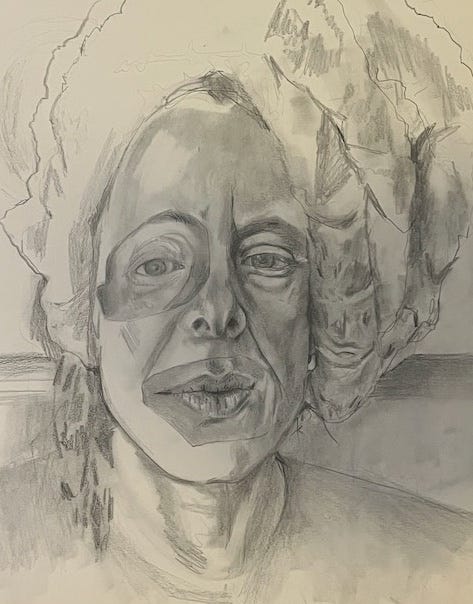
As we near the end of 2025, I find myself returning to the landscape of my doctoral work and to the speculative fictions I wrote during those years. These stories were a way of inquiring into the sociotechnical futures that we now find ourselves swimming in. My dissertation, Writing the futures imaginary: A digital arts-based inquiry into the futures literacies of teacher candidates, which I am releasing from embargo this week, maps the creative imaginings of a group of educators at an unsettled, transitional moment, a time just before generative AI entered our collective consciousness.
Among the questions I asked was whether they were worried about AI futures. Their responses were almost entirely ambivalent.
We met in November 2021, masked and nervous in our physical closeness, still in the throes of COVID. We gathered to feel, draw, and story futures without the pressure to fix them. This is the guiding ethos of fictopoeisis. It is inquiry that knows itself as fiction. It reaches into the space between the real and the possible, feeling the contours of that virtuality and sensing what is revealed there about our moment, and all the moments on the other sides of now.
The story I am sharing this month, The Unadorned, emerged from that period. It is not part of the dissertation, but I wrote and published it alongside that work in response to a call for speculative fictions about the future of education. It is a work of historical futures. It could only have been written before generative AI, yet it is somehow entirely about AI.
The story is an expression of nostalgia and curiosity. It is an attempt to stand in a distant future and look back at what it was like to be us before we were changed irrevocably. It considers the human longing for understanding and what we give up of who we believe ourselves to be when we begin to understand the languages of the universe. I tried to imagine a future being with embodied and cognitive access to all of digitized history, and to feel what such a mode of thinking might be like.
It has much to say about our moment. It touches on artificial intelligence, education, and identity, and on what is gained and lost in the devouring logics of understanding.
If a moral appears in the story, it is entirely unintentional.
I chose to accompany the story with a drawing of myself and my lesser adornments. The drawing is rough and unfinished, and that feels important at this moment. It carries both the movement and absence of my hand, the small errors of concentration and fatigue. It holds the way life intervened before I could find my way back to it. I crave these textures in a time when so much of our visual world is smoothed and polished. In a time when final drafts come too quickly. The roughness of the drawing feels human to me. It reminds me that not everything needs to be perfected or optimized, that we should keep drawing even when AI can draw for us, that something of our own unfinishedness is worth holding onto. The drawing is a composition copied from a collaged portrait made from AI images of myself, and it resonates with the story in ways I did not fully anticipate.
This is an Author Accepted Manuscript version of the following chapter: “The Unadorned,” published in Educational Fabulations: Teaching and Learning for a World Yet to Come, edited by Diane Conrad and Sean Wiebe, 2022, Palgrave Macmillan.
The Unadorned
Two children have moved to the carpeted area, bringing with them toys made of organic materials: wood, bamboo, cotton, bone. These antiquated toys, like the children themselves, show the wear of time and play. Child 479b leans her weight on a block train with a missing wheel. She has a scratch on her left cheek and her ponytail has shifted off centre. Beside her the slighter of the two males, Child 242c, sits cross legged, hunched over a box of beads made of bone and wood. He is digging with cupped hands and moving his lips as though whispering to himself. Although he cannot find the bead he is looking for, he does not seem to be frustrated. The motion of digging, or perhaps the wavelike sound of the agitated beads, has caused a fugue state to take hold of him, as though he is frozen in a recursive search loop. The boy’s central incisors are growing in at an alarming angle, pushing at his upper lip from beneath and causing a unique expression— a kind of puckered surprise that is both winsome and disturbing. I highlight these observations in the journal.
Two children have remained by the bookshelf. Child 469b lays on her back holding open a large hard-covered book above her, The Many Names of a Princess, as though shielding her eyes from the sun. I note the anachronistic simile. This girl has never lain thus beneath the full force of the sun; her skin, unadorned as it is, cannot protect her from its harmful rays. Though she is inside her fibrous clothing and the organ of her skin, she seems to me to be naked and exposed. My own fortified skin can withstand any range of poisons. And, yet, I too have never lain thus with a book beneath the sun. To take in a book, one word at a time, via the eye, is against my design. It would be a waste of my many affordances to engage in the thinness of one-word-at-a-time reading. I receive and decipher literature instantaneously, or in waves of information, accessible via any number of search parameters, and linked in infinite rhizomatic mappings to every other piece of information. My figurative musing about the girl and a book and the idea of a harmless sun emerges from this webwork of data. I note these thoughts in the journal.
“I can hardly stand to watch,” an attendant to my left says quite suddenly, throwing up their hands in exasperation. Their pen rolls audibly across the paper upon which they have been writing. I note the attendant has printed out their thoughts in Old Romans font, which seems to defeat the purpose of the pen. I have chosen a handwriting style averaged from a corpus of 17th century Dutch documents. We sit around a ledge of chromium-based alloy that encircles the playroom replication in the way of a ring of Saturn. We have been encouraged to use pen and paper to record our thoughts because these ancient technologies might elicit more affective biologically derived emotions and associations that may be embedded within our cellularity— affects that we have perhaps become alienated from. This smooth ledge is a kind of desktop for our journaling. Across from me, a third attendant does not lift their gaze from their paper, though it is evident that they are attentive to the sudden outburst. The sound of an Adorned voice in this observation room is unusual; it is rare for us to speak during our allotted shift. We have not been instructed not to converse, but in the many sessions I have sat through, I have only ever engaged in quick and softly uttered pleasantries with other attendants: Hello, Goodbye, May I take this seat?
I shift my gaze to the source of the attendant’s frustration. They have been watching child 432b work on a puzzle. The child is attempting to force a puzzle piece into place by pushing it with her fingers as though it were made of a pliant material that might change its shape.
“It’s a marvel they survived in the world for as long as they did” the attendant says, turning away from the playroom. I note the skin on their face is a smooth designer shade of cherrywood and in stark contrast to child 432b, whose porcine forehead has a flareup of eczema along the hairline.
“But look,” I say. “The child’s intention is changing; she is turning the piece on its edge. I think she’s making it walk. She’s playing with it.” Play is among the behaviours we watch for: how it emerges, what the behaviour produces, how it moves among the children.
“I need a new assignment,” the attendant says. “This is about as exciting as watching asparagus whither in a heatwave. Shouldn’t we be helping them? Is it right to let them struggle like this? One tiny adjustment and the child would be able to solve all the puzzles in the playroom. We could fix up that rash for her as well. Is it right to just let them languish in ignorance and discomfort?”
“Have you noted these concerns in the journal?” the third attendant asks, still refusing to shift their gaze from the boy with the beads.
“Yes, of course” the exasperated one says. Having left their chair, they move to the gym by the wall and execute a brief series of calisthenics, breathing rhythmically.
The attendant is not alone in their disgust and moral uncertainty. We were warned of these negative responses to the unadorned children and their artificial habitat: no adornments, no digital technologies, no technobiological modifications, no virtual embellishments, no simulations. Just flesh and bone and dumb, unyielding matter. Some attendants report nightmares and other lingering effects of the observation. My psychobiological response patterns, however, have been surprisingly ambivalent. The distaste is balanced with something I can only describe as a gravitational tugging sensation.
“To me,” the third attendant continues, “these children are merely the wake of a ship that has long passed. We have granted them protection so that they may live out their simple lives. To intervene in their trajectory would be pointless.”
“You say pointless,” the agitated one breathes, “I say merciful.” They jump down from the upper bar and sit back into the observation chair, turning their gaze to 280c, who is drawing with coloured wax at a low table. The wax combined with the boy’s uneven pressure effect a line that warbles and flakes. As I watch, the wax snaps in his fingers, causing a jag in the line, and then a sudden shift in the child’s interest. With the short end, he begins creating circular marks that bisect the original line. These rudimentary marks are the beginning of his slow uneven evolution into written language and pictorial representation. There are no guarantees that he will achieve anything like the limited mastery of which his mind is capable, nor how long his individual process will take, nor if he will live to achieve the fullest potential of his unadorned genome. If this were my child, I wonder, would I allow it to dangle thus at the end of this string of chance? If the child knew the outer limits of his capacities, would he continue to draw? What is the purpose of drawing other than to achieve representational mastery; indeed, to surpass and improve upon that which is represented?
My own children are to this boy what the sun is to a forest fire.
Now my attention is permeated by the slow wave of sorrow that has been moving through the collective portion of my consciousness since the physical death of our most recent children. These children, my own sixth child among them, did not live long enough to do anything like hold a stick of wax in the exquisite techno-musculature of their adorned fingers.
Each one of my six children has been an improvement upon the last. Each one designed with the latest research and biotechnical advances. The design of the sixth child though was too ambitious. We stretched the flesh too far, asked too much of it and saw the consequence of minds that were too diverse and powerful to adhere upon a single point long enough to develop self or integrate within the boundedness of their bodies. Due to a proliferation of attention, my child’s flesh failed to thrive. Throughout their long final days, we collectively held their bodies in our arms. I remember feeling the thin energy flushing through the skin, the subtle shimmer of their cellularity like evening lights among poplar leaves, while the infinite points of their attention roved and coursed robustly in weather-like patterns and so rapidly and in so many directions that the patterns became intricately confused and comingled. In the end, intelligibility dispersed and the child as I knew them died.
For months afterwards, I feebly followed the traces left by their gorgeous careening pathways of attention, my sixth child, who became, like all their siblings born under the same sign, spangled across the data-scape.
Many among us naturally attribute the current dysphoria to the collective trauma resulting from the loss of those children. Others attribute it to a psycho-spiritual disengagement at the molecular level with a material planet in distress. This research program, however, operates upon the assumption that it goes back to our biological roots. We have somehow lost touch with our flesh-bound desire out of which creativity is thought to emerge. It is hypothesized that our growing and some believe existential lack of interest in productive engagement with the material world is due to this forgotten desire. The economic ramifications have been profound. Cultural production has come to a virtual standstill as we choose more and more to lose ourselves among data patterns rather than engage in the slow temporality of the physical. At the research centre it is hypothesized that we might relearn and reintegrate this lost desire through neural repatterning and mimicry. Due in part to my own affliction, I have trouble caring about the outcome of our malaise.
The third attendant breathes and sighs, their eyes on a girl who has a bead in each of her cheeks and is tenderly fingering the mounds of flesh they have caused with her fingertips. “If it is a choice between adornment and this,” the third attendant says, “I think the choice is clear.” It has been an unusual day.
I return my attention to 469b. The precise angle of her foot balanced upon the opposite knee causes an emergent sensation in my minds.
Just now, 469b licks her lips and laughs out loud; her diaphragm pumps twice and a whooping sound emerges from her body creating an unpleasant crackling sensation in mine. The sound of her laughter causes the other children to look up and smile in agreement. I scan the room but cannot locate the source of their accord. The combined contingencies of the book she is reading, my heightened relational response to her, the colour of the cotton t-shirt she is wearing, as well as the smiles of the other children—all this coheres into the idea of a name for her: Blue. In thinking the name, the child has been named. In naming the child, I have shifted my consciousness – a vast network of associations occurs instantaneously, and the effect is palpable. I feel the sensation in my flesh— a sudden low-grade fever. I note this in the journal.
Shifting my attention away from the rhizomatic blues that have become suddenly insinuated across my consciousness, I regard the book the girl is holding within which there are 8 instances of her word/colour/name. The book is integrated across a webwork of interconnected themes and contents: Stories about animals, stories about girls, stories in English, stories steeped in colonial English tradition, stories by riverbanks, gendered stories, stories with able-bodied humans and BW45 skin tones, stories promoting ambivalence towards an unspecified monarchy, stories about unadorned children between the ages of 5 and 8, stories about nature and language, stories about forbidden knowledge and names, stories with talking animals and thresholds and liminal zones, stories about solitude, stories with gateways and rivers and inaccurate depictions of flora and fauna, storybooks with 21 pages printed with a fixed colour pallet, stories with 536 words and a mean sentiment value of -.3.
The many-named princess was crying by a riverbank. In the distance her castle cut a silhouette into the voided blue of the sky. She was crying because she longed to see past the reflection of her face and into the river where she imagined all manner of wonderful things must be swimming in their watery world.
She was crying also because the afternoon was so long and lovely and she had no one to share it with. No one but her own reflection. Her name was Adalina Juniper-Lune Bailey Genevieve Emily-May Thompson the Third, and the name was embroidered in curving letters of golden thread in a column down the front of her dress. Her tears could not extinguish the glow of the letters that caught the afternoon sunshine and seemed to be alive as golden caterpillars clinging to the blue silk of her gown.
Soon a horse walked by and found the princess weeping softly. He was a kind and special horse and so he offered her passage to another world.
“Walk underneath my body,” he said sweetly, “and you will find yourself in the world you long for.”
Once her astonishment at having been spoken to by a horse had subsided, Adalina Juniper-Lune Bailey Genevieve Emily-May answered cautiously.
“Why should I leave the only world I’ve ever known?”
“Because when you enter to the world I speak of, you will know the language of all the living creatures of the world. Not only the horse, but the squirrel and giraffe and all the dwellers of rivers and streams—the trout and gadfly and mosquito, who, incidentally, has a wonderful sense of humour.”
The princess clapped her hands, delighted. “I should love to speak with a funny mosquito!”
“And if you move still deeper into this world,” the horse continued, “you will know the words of the trees and plants and the fungi that grows in a great invisible hammock beneath the ground.”
The princess dried her eyes and sat up straighter.
“And if you move still deeper into this world, you will come to the ocean. There you will converse with the tides and currents and know the subtle intelligence of seafoam. If you are still hungry for conversation, you might get into a boat and row yourself deeper into this world to a place where you may discuss all the important matters of the universe with the sun and the moon and the planets beyond.”
Without a care for her silk dress, the princess got onto her knees and prepared to pass beneath the horse.
“But, I must warn you” the horse cautioned. “There is a small cost.”
“I have riches beyond your wildest dreams,” she said and motioned to the castle in the distance. “I can pay you in gold or silver or jewels.”
The horse smiled. “Your gold means little in our world,” he said. “However, for each language you learn, you may pay us in names.”
“I have so many!” said Adalina Juniper-Lune Bailey Thompson Genevieve Emily May. “I don’t mind giving up a few.”
With that, the princess passed on her knees beneath the body of the horse and as she did, a single golden filament came loose from her dress and caught in the grass by the riverbank,
Y..A..M unravelled gently from her dress. Then Y..L..I..M..E… But Adalina Juniper-Lune Bailey Genevieve did not seem to care, for she was deep in conversation with a mallard…
Blue has turned onto her side and curled up her legs. She has created a tent of the book by wedging one of its covers into the pile of the carpet. The other cover rests upon the back of her head so that her face is obscured from view. I know, however, that she is sucking her thumb under the cover of the book. I have seen her engage in this behaviour before. More and more now, she hides it, especially during play time. Her mother has allowed this habit to take hold, this action of self-soothing and retreat. It is as though Blue might suck her way out of the room and into her own body and back towards an infancy she no longer remembers. Indeed, the inward curve of her body, away from her playmates, creates a kind of private cocoon of quiet and calm. I feel I know why she engages in this behaviour, what it does for her psychobiology—she becomes self-reliant, a mobius strip of self-soothing, a netting effect spreading from within her, like leaning inwardly against a giving surface. I wonder if this sensation is related to the equanimity that I find in my evening dose, when my minds all hum at the same frequency and my constant searching and cataloguing becomes wavelike, rhythmic, and I slip into a state akin to calm. I note this hypothesis in the journal.
Just now child 458b peels the book away from Blue who quickly pulls her thumb out of her mouth and blinks up into the face of her playmate.
“May I read with you?” 458b asks.
“Sure,” Blue says and sits up.
She shuffles her body so that she is sitting beside child 458b. They spread the book open across their laps, but instead of reading the words that are printed there, they begin to make up a completely unrelated and nonsensical story, as though they had some previous arrangement to do so.
Can it be that these children are our ancestors? These children who perform and compute less in a waking day than our children do in a minute of sleep? Their single minds are almost entirely inactive; their bodies expend such wasteful amounts of energy; they are utterly incapable of precision. And yet we are here, observing them with the hypothesis that they have access to something we have inadvertently lost or suppressed. We know what creativity is and yet we cannot produce it. We have hit the outer limit of our differentiated and flesh-bound potential.
“I’ll be the princess,” Blue says. “You be the horse.”
“No, let’s both be princesses” child 458b says.
“Okay, we can be sister princesses,” Blue says. “Let’s pretend the horse is our father and he is punishing us for something by making us clean all the stones by the riverbank.”
“But look,” child 458b says, “the stones are already clean.”
“Okay, well maybe he’s making us gather them and put them somewhere.”
“Or maybe we’ve run away from the castle and the horse has come along to protect us.”
“And the river is too cold to cross. Also, we don’t want to get our clothes wet.”
“Let’s find clothes to wear,” Blue says. She takes the book they have not been reading and slams shut the covers causing a gust of wind to blow in her face. The sensation seems agreeable to her, so she does it again. Then the girls leave the book on the carpet and run to the area where the clothing is kept. There, they begin tearing through the items in search of something to wear and it is as though they know exactly what they are looking for.
Blue’s ignorance of her own obsolescence is mesmerizing. For a while, I trace her name (as I sometimes trace the patterns of my lost child) through a webwork of associations: the Japanese ghost bonsai, a blue pigmy butterfly, the blue sky beyond our bell jar, a blue guitar, a blue period, Miles Davis’s Kind of Blue, a string of blue Akoya Pearls, the blue tongue of the long extinct northern skink, the blue ice-moss of Bolivia seeded to protect the snow line and all the water-based organic lifeforms still extant there. Blue would perish if she were exposed to those thinly oxygenated mountaintops, forever changed by blue. Seen from above every austral winter, the mountains blink from white to blue to white to blue. Snow falls and is snuffed out by the aggressive and insulating blue. Snow falls again and the surface is reclaimed by those powdered bryophyta eyelids. Satellite videography passes before my attention, and I note how the face of the world has mountain eyes that cry and blink at the cosmos.
When I was a child, my parents would threaten to send me to live with Blue’s people on the coast and off the grid of the Pacific Northwest. When I strayed from my task, or resisted my meditation, or succumbed to the frivolity of random searches they would say, “Do not waste your adornments or we’ll send you to live with those who have none! Do you want to dig your own holes? Think only one thought at a time?! Do you want to be oblivious to everything except what is right in front of you and never know what is coming?”
For three hundred years the last of the unadorned lived like that, exposed and naked to the changing wilderness, reproducing their numbers via the trauma of mammalian birthing, reifying the untampered genome. Illness for them was a loving rebuke and technology was the ultimate corruption. Of course, their beliefs did not protect them from the years of drought and the fires that culled their numbers down to a handful.
When the deserters finally came, we were ready to receive them. Five of the eight were pregnant when they arrived at our doorstep, on foot, wearing shoes they had fashioned for themselves with their own hands. They walked down the mountainside slowly, as though they had been woken from the depths of some ancient sediment: living fossils, ghosts, fragile as stalks of grass, organs exposed to the world, minds quiet with a single language and their lived memories alone. I record this associative figuration in the journal.
“Look at that,” the third attendant exclaims and points a long finger into the simulation before us. The attendant’s finger merges with the shape of the boy they have been watching who has threaded some beads onto a wire and twisted it in such a way that it loosely resembles a human figure. Or perhaps it is only in the way the boy is holding the self-made toy and relating with it, that the mess of beads and wire resembles anything at all. He is whispering to the thing he has made and shifting it about in the air before his face with deep satisfaction.
“His entire attention is consumed,” the third attendant says, shaking their head.
“Isn’t it sad how easily they are amused?” the attendant beside me remarks. “I tell you, if these unadorned children are our last hope, then we are as doomed as they were.”
Blue has pulled on a large white lab coat and a straw hat. She climbs onto a chair and stretches her arms above her head. She laughs again, that strange whooping sound that causes me to cringe and crackle along the fissures between minds. My adornments are so entwined with my knowing and being that I cannot imagine myself without them. Blue stands before me, viscerally familiar and yet utterly alien; she is as unintelligible to me as the long extinct horse and the laughing mosquito. Unlike my peers though, I think there may be something to be learned from her, though I wonder if I am capable of learning it. Indeed, if offered, I might give up one of my lesser adornments to follow the golden filament back to Blue, to know her single mind and the emptiness that data has claimed in mine.
The thought is pleasant but momentary; I note it in the journal.