
Self Portraits in AI
on the academic headshot, self-dissection through portraiture, identity as curriculum, and the fiction of a face
It never occurred to me how many faces there are. There are multitudes of people, but many more faces, because each person has several of them.
—Rainer Maria Rilke
Performance of self
The headshot is an anxiety-inducing bit of necessary self-promotion in academia and professional life more broadly. Visual partner to the prose bio, one sends these texts out into the world together, to announce one’s physical existence and one’s desire to be recognized. It is the headshot, however, that steps out ahead of the bio and fills the stranger’s imagination with a fabricated fullness of presence that, given its partial nature, can only be—to varying degrees of severity—wrong.
Because of this, for me, the headshot is aptly named, as it evokes a very particular kind of existential dread.
The image is so beside the point, such a surface-level stamp to place upon the body of one's intellectual and creative endeavours. It is a self-inflicted branding. Branding—with etymological roots in the practice of marking flesh with a hot iron.
The well-branded individual enjoys certain benefits “when competing for work, seeking advancement in specific occupations or professions, or pursuing a career path that leads to higher financial earnings” (Scheidt et al., 2020, p. 9). The headshot, therefore, matters.
As a text it is performative and necessarily contrived—both the image itself and the choice of the image. There is a compounding of decisions in the headshot. A seemingly benign photograph will take on new complicated dimensions when positioned as a headshot. This is the picture she chose?!
Scientific evidence supports the rationality behind my miasma of discomfort around choosing a headshot. White et al.’s (2017) Choosing face: The curse of self in profile image selection reports on a study in which participants selected from 12 images of their own face, the ones they would most and least likely use as a profile picture across three social networking contexts. Participants were asked to repeat this task for a stranger of the same gender, and then to rate all the images on five social traits: attractiveness, trustworthiness, dominance, competence, and confidence.
The results indicated that the images selected by strangers consistently generated more positive first impressions—especially in terms of trustworthiness and competence—than the images participants selected of themselves. The authors argue that the familiarity we have with our own faces may interfere with our ability to choose images that align with how we desire others to perceive us.
However, in the study, there was no attempt to determine whether the positive impressions of trustworthiness, for example, were true. This is all a matter of in/effective seeming.
Because there are so many ways a face can be misread.
Resting bitch-face, for example, is a widely recognized facial phenomena. It describes when a person’s features, in a neutral or resting state, appear to form a grimace, sneer, or faint expression of disdain—an affective signal that bears no relation to internal feeling. Abbe Macbeth, one of the scientists of a 2015 study, explained: "We see that people who have this RBF expression [have] double the amount of emotionality expressed.” For someone with RBF, their faces are constantly misread.
This is not a statement on bitches or the misogynist shittiness of the concept of RBF. “Those afflicted with RBF may show a jump of trace emotions as high as 6% and most of the emotion expressed is of contempt: the feeling that something is worthless or deserving scorn."
This is about the misfiring signals of a face.
I’d like to take the argument one step further and suggest that all faces, to varying degrees, are poor maps of the particularities of our inner worlds. I am not saying there is no reciprocal relationship between one’s face and one’s being. It’s just that this relationship is far more complex than any single gaze might fathom. Even the gaze of a loved one can be misreading—let alone the gaze of a potential employer.
All headshots are fictional gestalts that we cast into the digital stratosphere, ahead of our bodies and into the minds of those we hope to impress.

A good friend of mine once described her desire to step away from her voice. She was studying jazz as a vocalist and she explained to me, one evening when we were discussing feedback and the creative process, how difficult it was for her to separate herself from her instrument—her voice—and receive criticism without all the obscuring layers of emotional impediment and self-identification and defensiveness that she needs to get over in order to improve her craft. She described how she wished she could just put down her voice, like a tuba, and walk away from it. Go have a glass of wine, get some perspective.
How I would love to put down my face! Just put it down, on the tabletop, in order to have a better look.
Then, maybe, to take it apart. Run some experiments on it. Like, how much change can I enact upon my visage before I stop recognizing myself? Where does my image end and someone else’s begin? Who are the others at the edges of my face?
I desire to disassemble my face, feature by feature, and see the narrative workings exposed. Trace the flight lines of a face from the twinge of a muscle outwards into the memory of a stranger. I desire to untangle this skin mask I wear, this expressive plate of flesh, from behind which I gaze out onto the world and imagine the minds of others imagining me.
How, exactly, do I come off?
Notes on composing the shot:
Be careful with likability. The merely likeable are easily derided.*
A little fierceness is necessary if you want to be respected.
The intensity of your gaze, clench of your jaw, unflappability of your expression – these can indicate an important note of wild and unruly free-thinking.
Gesture towards the tantalizing thinness of membrane between your professional exterior and your radical, unbounded interior world.
Be wary of this thin membrane, as it can also be read as cheap fabric that shows the dimples and panty lines of your too-naked inner life.
The business suit, the oversized glasses, the windswept hair, the rose-garden background, the toothy smile, the smirk—they are, each of them, rhetorical moves in the genre of the headshot.
We all see these moves we make, and agree not to discuss them.
It is not enough to be attractive. You can be too attractive or attractive in the wrong way or seeming to seem to want to seem to be attractive, which is off-putting.**
Being good-looking can be irritating; cuteness can revoke your status as a serious person. Both too old and too young are dismissible in different ways, especially in a woman.***
Disassembling the Self
My favourite short story, Exhalations, by Ted Chiang, is about the desire to disassemble the self, to understand the workings of one's own mechanisms—one's own strange intelligence—to pinpoint the location of one’s memories. In an other-than-human voice, lacking in all human histrionics, just quietly curious and methodical, we read the careful narration of a process of self-dissection:
“I began by removing the deeply curved plate that formed the back and top of my head; then the two, more shallowly curved plates that formed the sides.… what I saw exposed was my own brain. It consisted of a dozen or more sub-assemblies, whose exteriors were covered by intricately molded shells.... Even with what little I could see, I could tell it was the most beautifully complex engine I had ever beheld, so far beyond any device man had constructed that it was incontrovertibly of divine origin. The sight was both exhilarating and dizzying, and I savored it on a strictly aesthetic basis for several minutes before proceeding with my explorations.”
Each of our faces coheres in each moment, on the crest of an unfathomable wave of evolution, time, life experience, and sun exposure. Faces express an emotionality and narrative richness that is always adjacent to the unfathomable complexities of one’s passage through time.
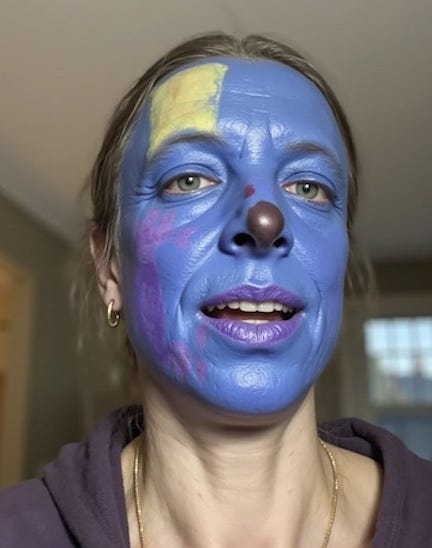
Our faces are useful fictions. Of course we participate in the illusion, and seize a measure of agency in the rigged game of biology. We participate creatively in the always fictional image of our face at any given moment: Makeup, botox, face paint, lighting, jaw exercises. This is not just a game for women.
Reassembling the Self
Cindy Sherman’s series of AI portraits were partly an inspiration for the methodology of the images included in this essay. It was sometime in 2023, as I lay scrolling my Instagram feed, when her selfies came shrieking into my eyeballs. My exhilaration was both for the delicious ugliness of the portraits and for the reception of the portraits, which was equally bonkers. The anger and vitriol people lobbed at her in the comments! I can’t find the original posts now, but even in articles charting the response to the images, you will find comments like these:
“Soooo many photographers are being sucked into this. It's like heroin - hey just try it once, go ahead - you don't realize how it's inevitably going to destroy you.”
Come on. It’s not AI that will destroy Cindy Sherman, or any of us! It’s time! Time is coming for us all.
Sherman’s portraits play with her own advancing mortality, along with the insane contortions we put our faces through in our desire to be desired, which is just another way to stave off the bald-faced fact of our dying.
I love the meanness of her portraits. The way she fearlessly rips apart her own face. Exposing her mortality in contortions of flesh: pinched and puckered and smeared. The hyper-defined and deeply textured skin. The wretched, ugly, vain, white woman she also is.
I see myself in those images—my own neurotic and vain overthinking of the headshot—my own aging faces.
Cindy is adamant that she did not, in the end, use AI in her compositions. I wish she had used AI. She might as well have. I think it would have been a more honest commentary upon the technologized image - its complicated and ethically fraught wrongness. Naturally, she is worried about consent, and also about being stolen. This makes sense as Cindy has something valuable to steal, whereas I do not. For the New York Times, Princenthal (2024) quotes Sherman, “‘I did try using it to see if it could at all replicate something in the style of Cindy Sherman.’ The result, [Sherman] happily reports, was ‘pathetic.’ But, she conceded, ‘That’s not to say it’s not going to happen.’”
Face as curriculum
I got to thinking: I’m not squeamish about it. Maybe the answer to all my headshot problems is AI? Because the face is always already a composite—recycled and reassembled, continually shaped by the mysterious choreographies of the universe, time, and skin care routines—why not, then, plump our lips a little, with some data scraped from a billion of these faces, both real and imagined?
So I began feeding my face into a model—all kinds of images of me. You will say, “It's not you." This is both true and utter garbage. Of course it's me! Of course it's not me!
The first outputs came back determinedly young, beautiful, and boring (though my daughter was very impressed!). So, I started looking for models that would stay closer to my actual face. Slowly, a measure of uncanny familiarity began to emerge in the close-but-not-quite-ness of these facial recompositions. I began sketching the images, getting lost in the strange permutations of representation filtered through algorithms and refracted again through my own pencil lines.
I presented part of this experimentation at an arts-based education conference recently, along with the sketches. Someone in the audience asked about the question of ethics, and we agreed one could only perform such experiments upon one’s own face—one’s own scholarly identity.
After the presentation, a good friend said to me, as if I had just done something very brave and very embarrassing: “That was a lot of you up there.”
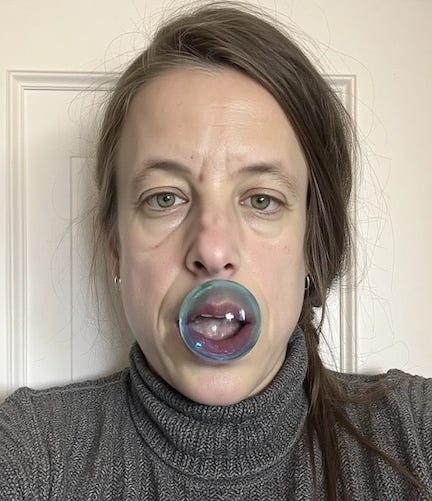
I love the idea of hurling my face out into the othering intelligence of the inhuman machine, to be torn apart—ravaged if you will—by the devouring algorithms. Gnashed into a billion fractalized pieces to be reabsorbed infinitely and recursively, forever.
I love the idea of my face, spangled across an uncaring, all-consuming, consent-be-damned datascape.
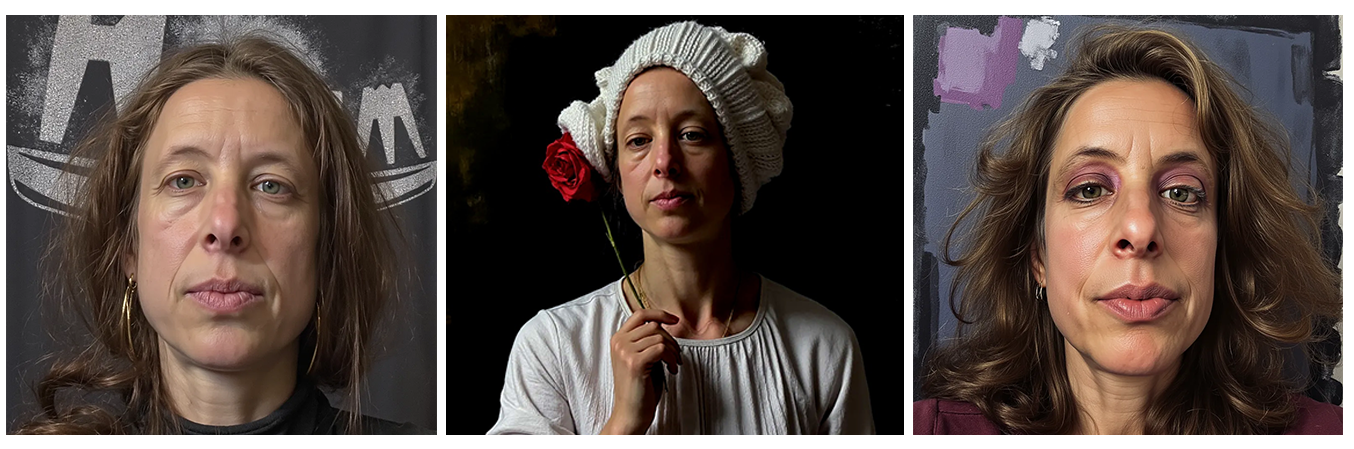
Images of our selves are elastic and permeable. We send them into the world to be misread, constantly. I have chosen the ones in this essay to communicate the weird fictionalities that are also the reality of a middle-aged face in search of an academic home. To demonstrate how this face constantly betrays me in the minds of others.
But it’s even more than that: I like myself in these pictures. In them I am grotesque, gorgeous, and fictional as hell.
(Insert a “regular” headshot here.)
Footnotes:
* It’s just that one generally doesn't have an Annie Leibowitz kicking around in the other room for when one is ready for a portrait that will capture the truth of one’s heart and soul, one’s worth and capacity to contribute to a richness of discourse and scientific discovery!
** In the end, we are all swimming through a sea of gazes, with all their complicated histories, desires, revulsions, judgements. We move through these gazes, hoping to be seen, respected, desired, trusted, loved. Or maybe just hired.
*** It’s just so goddamned much. One is justified in staying home and turning off all the cameras.
What a fascinating read. The topic itself is provoking. The way you explore it engages thought and also emotion as it is relatable. It’s likely going to stir my mind for a while. Thank you!